
Work is becoming agent-mediated. And now comes the interesting part.
The shift from human-at-keyboard to human-directing-agents is just getting started.

For forty years, work meant a person at a keyboard in a chair. You went to the cockpit to start and left it to stop.
Then came smartphones and global connectivity.
What’s coming next will change the shape of how, when, where and WHY we work.
At yesterday’s Google I/O, we saw the latest glimpse. Google pushed voice across its entire work surface: talk, and a document writes itself; your inbox sorts itself; your half-formed thoughts become structured notes in Gmail and Docs.
It launched Gemini Spark, a personal AI agent that lives in the cloud, runs on dedicated virtual machines, and keeps working even when your laptop is shut. As Sundar Pichai noted, we’re entering a world where models like Gemini Omni can “create anything from any input,” spanning text, images, video, and audio at once.
Zoom out.
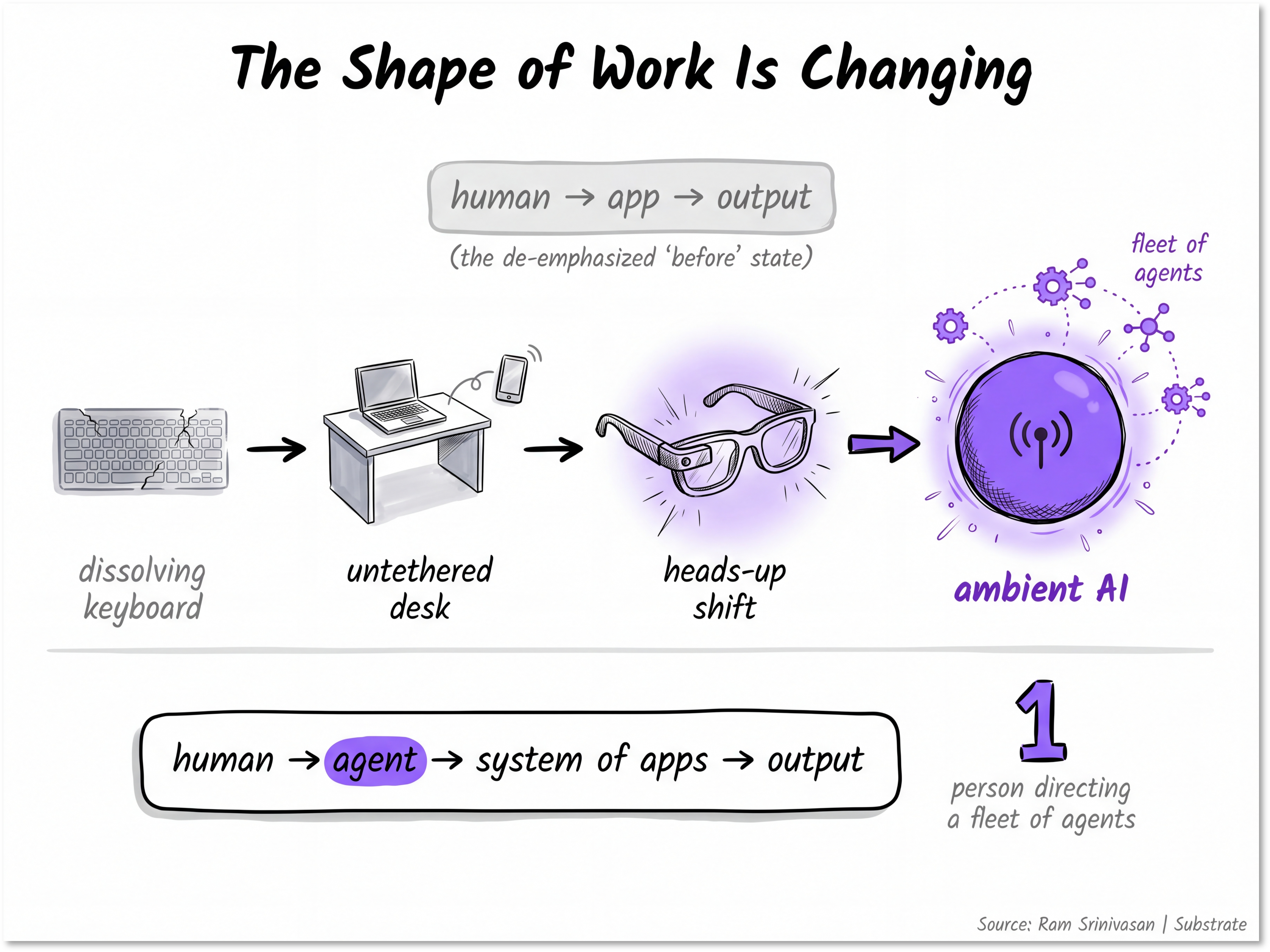
1\ The keyboard was the first interface to dissolve.
Voice is replacing it. We’re already seeing tools that let builders dictate code and orchestrate development flows without touching the keys.
2\ The human‑tethered desk was next.
Low-latency, high-bandwidth internet plus the smartphone morphed “desk work.” Now remote-controlled agents can run on your machine while you steer them from your phone. This is exactly the pattern Anthropic is exploring with Claude Dispatch and what OpenAI is pushing with Codex-style mobile coding assistants.
3\ And now, the smartphone’s reign may be ending.
This is a growing view across Silicon Valley and among the companies that actually ship the silicon. Qualcomm, whose chips sit in billions of devices, is already demoing on-glass GenAI experiences and smart glasses built with Google and Samsung that shift attention from handheld screens to heads-up, context-aware computing.
4\ What comes next may be a combination of wearables, eyewear, and more.
AI and AR glasses from Google and partners move the agent off the screen and into a “heads-up display.” They see what you see, hear what you hear, and let an agent act on top of your field of view—overlaying information, capturing context, and handling tasks in the background.
5\ And finally, ambient AI.
Think Iron Man’s JARVIS, but as a product category, not a movie prop. Google is explicit that agents like Spark are meant to be always-on, long-horizon assistants that manage email, schedules, and tasks continuously rather than waiting for you to sit down and type. The meeting records itself. Your workflow doesn’t start when you open the laptop; it starts listening the moment you show up.
Now watch what that does to work.
One example is AI-native pods, sometimes just one person directing a fleet of agents.
We’re already seeing early versions of this: individual operators combining desktop-controlling agents, cloud-based personal agents, and code assistants to ship what used to take full teams. Companies like Coinbase and Meta are experimenting with agent-centric environments and tooling because they see where this is going: fewer people, more leverage per person.
Of course this may not be for every role and every team today, BUT it is the direction of travel.
The unit of work is shrinking while the leverage per person grows.
Every knowledge worker equipped with far more range can research, build, communicate, and own outcomes end to end. The stack is shifting FROM: human → app → output, TO: human → agent → system of apps → output
Of course there are real risks.
The next decade will compress a century of innovation.
That means disruption, uneven adoption, and new forms of dependency. Not everything moves at the speed of software. There are fundamental tensions between regulation, enterprise decision-making, infrastructure realities, and the need to bring people along this journey with care and compassion.
Which brings us to the most interesting part.
You can build the solution you want to see in the world.
To solve the problems you foresee, at the intersections you understand best. The engineering team you used to need is increasingly a set of agents in your pocket and in the cloud.
The barrier to building something real has fallen far enough that the only thing between you and a launched business is this question:
What’s worth solving?
Until next time,
Ram